

Key takeaways
- Critical industries such as aerospace, defence and rail build systems designed to operate for 30 years or more, and almost every one of those systems depends on electronic components.
- Most semiconductors are only manufactured for a fraction of that time, so the parts inside long-life systems routinely go obsolete while the system is still in service.
- Electronic components fail for three main reasons: improper screening, environmental stress, and counterfeits entering the supply chain.
- Force Technologies has been solving this problem since 1986, combining MIL-STD-883 testing, AS6081 counterfeit inspection and controlled nitrogen storage that keeps components usable for 15 to 30 years.
In a recent episode of Force Tech Talk, our CEO Karen Salmon sat down with Ben, our Head of Engineering, and Charlotte, our Sales Manager, to answer a question we were asked at an Institute of Obsolescence Management meeting: what does Force actually do about reliability? This post unpacks that conversation in plain English.
What does Force Technologies do?
Force Technologies keeps safety-critical electronic systems running by supplying, testing, authenticating and storing the semiconductors they depend on, long after the original manufacturers have stopped making them. We have been solving IC obsolescence since 1986, we are certified to AS9100 Rev D, and we are audited every year. Our customers are the people who cannot afford a single component failure: aerospace, defence, rail and industrial programmes where equipment is safety-critical and, in many cases, life-saving.
What counts as a critical industry, and why do electronics matter so much?
A critical industry is one where a failure puts lives, national security or essential infrastructure at risk. Aerospace, defence, rail signalling, energy and medical systems all qualify, and every one of them now runs on electronics. A modern aircraft, radar system or train control unit contains thousands of electronic components, and each one has to perform correctly in harsh conditions: extreme temperatures, high G-forces, shock and constant vibration. In these environments there is, as Charlotte put it in the podcast, essentially zero margin for error.
How long are electronic components expected to last?
The systems last far longer than the components made for them. Aircraft, defence platforms and rail infrastructure are designed for operational lives of 20 to 30 years or more, and many serve well beyond that. The semiconductors inside them tell a different story: commercial chip manufacturers typically produce a part for only a few years before moving on to newer designs. When production stops, the part is obsolete, but the aircraft or signalling system that relies on it may still have decades of service ahead.
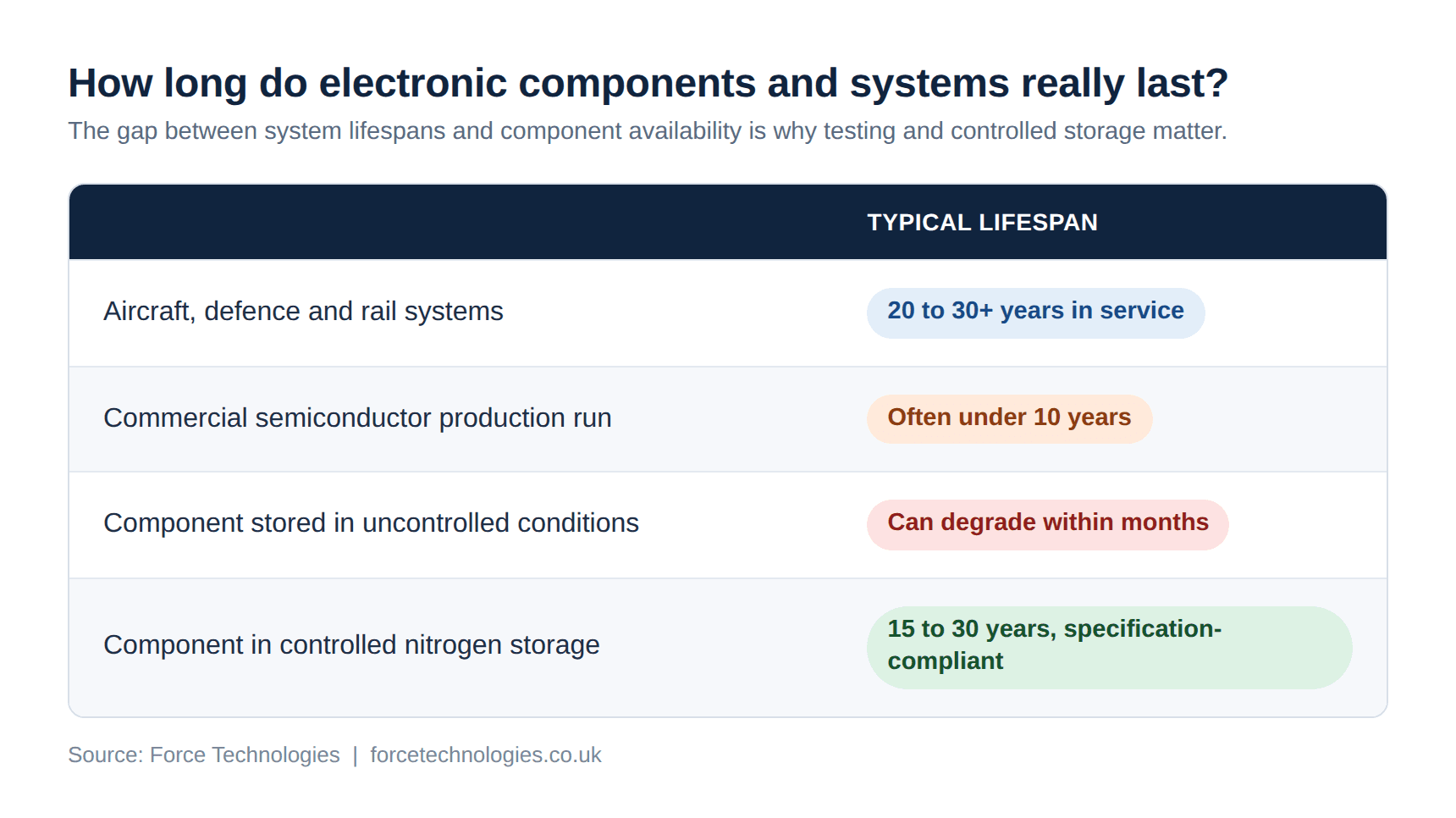
That mismatch is the whole problem. You cannot simply buy a replacement chip in year 25 if nobody has made it since year 8.
Why do electronic components fail?
There are three main causes of component failure in a critical system. The first is a straightforward electrical failure, usually because a device was not properly screened before it went into the application.
Like most electrical goods, chips can suffer what engineers call infant mortality, where a device dies in the early stages of its life. The second is environmental failure, where high G-forces, temperature extremes, shock or vibration physically damage the component.
The third is counterfeiting: a part that is not what it says on the tin. It may carry the wrong markings, come from a different manufacturer entirely, or contain a completely different die inside the package.
The market is unfortunately flooded with counterfeits, and there have been well-publicised cases of fake parts reaching aviation and defence systems.
How does testing prevent these failures?
Each failure mode has a matching test. For infant mortality, the MIL-STD-883 specification calls for burn-in testing, a high-stress test run over a set period that weeds out devices which would fail early in service. We carry this out on all the military-grade product we supply.
For environmental failure, there is a whole suite of tests: constant acceleration, where a part is mounted in a centrifuge and spun at high speed to prove it will not shatter; temperature cycling, which rapidly heats and cools the device; plus shock, vibration and electrical testing.
Aircraft customers in particular insist on shock and vibration testing, because the parts must survive exactly what they will experience in flight. Many customers now ask for additional testing beyond the standard, tailored to their specific application, and we capture those requirements at the enquiry stage and write them into customer-specific specifications.
For counterfeits, we developed and trademarked Authenticare, our anti-counterfeit testing programme, which has evolved in line with the AS6081 standard that most aerospace and military customers now strictly follow.
Testing runs from electrical checks through to physical inspection, X-ray and decapsulation, confirming that what is inside the package is exactly what the label claims. Once a customer sees what each level of testing prevents, the modest cost difference rarely puts them off, and for many applications full AS6081 testing is simply non-negotiable.
Why do you need long-term storage as well as testing?
Because a tested part is only safe if it is still in specification when you finally fit it, which may be decades after you bought it. The sensible answer to obsolescence is to buy enough stock for the remaining life of the programme, but components left in uncontrolled conditions can degrade within months through oxidation, moisture absorption and electrostatic damage.
Our Titan long-term storage facility holds parts at 15 to 25 degrees Celsius in an inert nitrogen atmosphere with less than 0.1 per cent oxygen, with continuous environmental logging and audit-ready records. Stored this way, components can remain specification-compliant for 15 to 30 years, ready to be re-tested and released when a programme needs them.
The bottom line
Critical industries build systems that outlive their own electronics many times over. Bridging that gap safely takes three things: rigorous screening so weak parts never enter service, authentication so counterfeits never enter the supply chain, and controlled storage so good parts are still good in 20 years' time. That combination is what Force Technologies has been providing for four decades.
Want to hear the full conversation? Listen to this Force Tech Talk, and send us your questions for the next episode, where Karen, Ben and Charlotte will be discussing the difference between industrial and military grade products.

Written by
Charlotte HughesCommercial Director, Force Technologies
Charlotte Hughes is Commercial Director at Force Technologies with a degree and Masters in Psychology and is an accredited Applied Behaviour Analyst. She transitioned from internal sales and operations to managing sales, key accounts, and the distribution network. Charlotte actively participates in industry events and memberships, leveraging her expertise in sales, customer service, procurement, and product management within the electronics obsolescence sector.
Charlotte regularly engages with and attends events hosted by organisations Force Technologies is a member of, such as Joscar, Make UK Defence, Aerospace Wales and the International Institute of Obsolescence Management – all with the aim of networking, gaining and sharing industry knowledge and expertise.
Specialisms
Charlotte specialises in sales, customer service, product procurement, product management, and operations. She holds Associate Member status from the International Institute of Obsolescence Management.
Certifications
Charlotte holds Associate Member status from the International Institute of Obsolescence Management.