The problem with storing semiconductors badly
Defence platforms and aerospace systems run for decades. The components inside them may be discontinued in years. When a critical semiconductor reaches end-of-life, the programme that depends on it does not simply stop but without a storage strategy, it can quickly stall.
Semiconductor ICs are not passive objects. In uncontrolled conditions they degrade through oxidation, moisture ingress, lead corrosion, and packaging breakdown. A part shipped in perfect condition can become unfit for use within a few years if it is kept in an ordinary warehouse. For fine-pitch devices or bare die, the risks are even greater.
The real cost is not the component. It is the investigation, emergency sourcing, qualification delay, and potential redesign that follows when a stored part fails at the point of deployment.
What proper long term storage actually involves
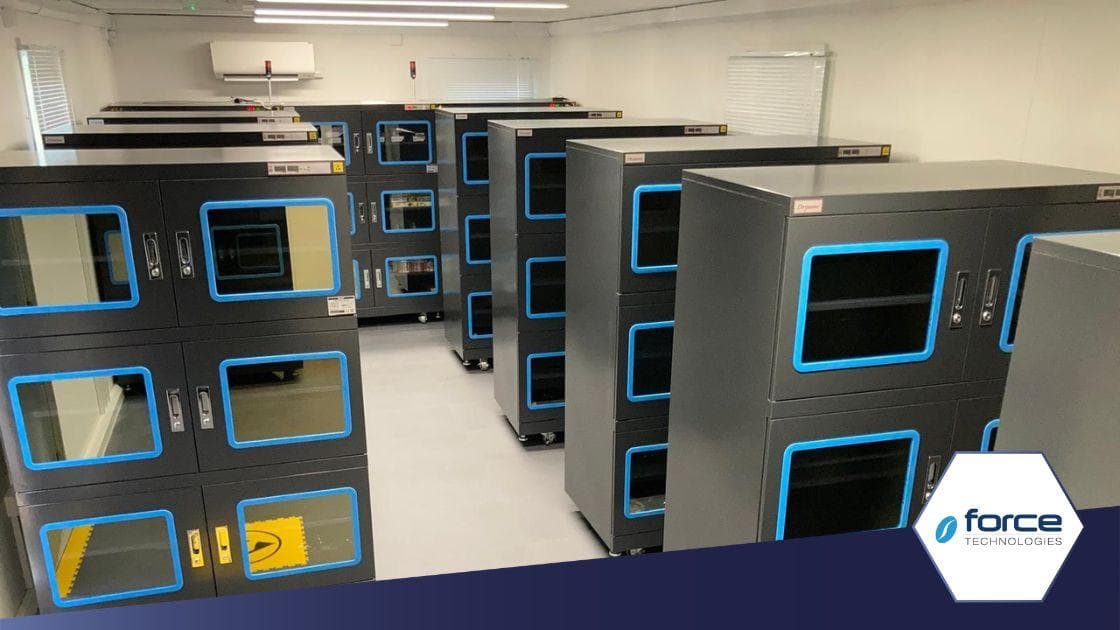
Compliant long term storage is a managed environment, not a shelf. Force Technologies’ Titan Long Term Storage facility is built around J-STD-033D and JEP160 the industry standards governing moisture sensitivity and long-term preservation of electronic components.
The controls that protect stored inventory are:
- Temperature and humidity regulation. Consistent conditions are maintained throughout the year, removing seasonal variation as a risk factor.
- ESD protection. Electrostatic discharge can damage semiconductor devices invisibly. Purpose-built ESD environments eliminate this risk entirely.
- 99% pure nitrogen atmosphere. Nitrogen displaces oxygen and moisture the two primary drivers of oxidation and corrosion at component level.
- Periodic testing and known good die (KGD) validation. Stored inventory is tested at intervals, including wafer-level probing at operational temperature extremes. This is what separates genuine storage management from warehousing. Parts are application-ready when you need them, not just physically present.
How Titan Long Term Storage works for your programme
Titan Long Term Storage is Force Technologies’ dedicated facility for assembled ICs and bare semiconductor die, based in the south of the UK. It is used in two main ways.
The most common is supporting a last time buy. When a manufacturer issues an end-of-life notice, the window for purchasing remaining stock closes quickly. Organisations that act early can secure enough inventory to cover their programme’s remaining lifecycle but only if that stock is properly preserved until it is needed. Titan provides the controlled, monitored environment that makes a last time buy a genuine long-term solution rather than a deferred problem.
Titan is also used for ongoing lifecycle inventory current stock held on behalf of clients who need confidence in their supply for future builds or service contracts.
In both cases, full traceability is maintained throughout the storage period, and the service is backed by AS9100 Rev D quality management.
Key capabilities at a glance:
● J-STD-033D and JEP160 compliant storage
● ESD-protected, temperature and humidity controlled environment
● 99% pure nitrogen atmosphere
● Periodic KGD validation and packaged IC testing
● Wafer probing at minimum and maximum working temperature
● Flexible plans for 10 years or more
● Full traceability throughout
Speak to Force Technologies
Force Technologies has been supporting long-lifecycle defence and aerospace programmes since 1986. Titan Long Term Storage sits within a complete obsolescence management service from last time buy strategy through to form, fit and function replacement and certified assembly.
If you are managing a programme where component continuity is a concern, we are happy to talk through your options.

Written by
Charlotte HughesCommercial Director, Force Technologies
Charlotte Hughes is Commercial Director at Force Technologies with a degree and Masters in Psychology and is an accredited Applied Behaviour Analyst. She transitioned from internal sales and operations to managing sales, key accounts, and the distribution network. Charlotte actively participates in industry events and memberships, leveraging her expertise in sales, customer service, procurement, and product management within the electronics obsolescence sector.
Charlotte regularly engages with and attends events hosted by organisations Force Technologies is a member of, such as Joscar, Make UK Defence, Aerospace Wales and the International Institute of Obsolescence Management – all with the aim of networking, gaining and sharing industry knowledge and expertise.
Specialisms
Charlotte specialises in sales, customer service, product procurement, product management, and operations. She holds Associate Member status from the International Institute of Obsolescence Management.
Certifications
Charlotte holds Associate Member status from the International Institute of Obsolescence Management.