
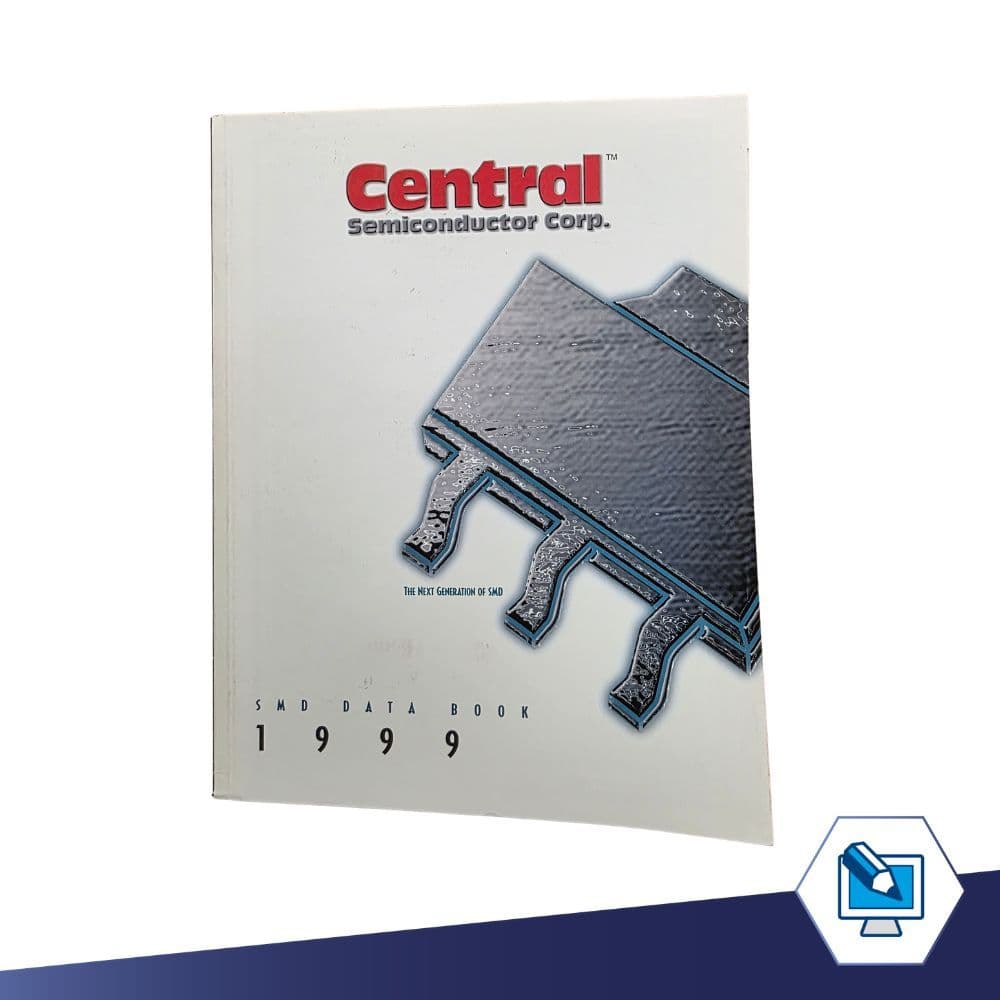
What is the Central Semiconductor SMD Data Book 1999?
It is the 1999 edition of Central Semiconductor Corp.’s printed catalogue of surface mount devices, and it is now part of the Force Technologies Data Book Library. The cover is headed "SMD Data Book 1999" with the line "The Next Generation of SMD". Inside, the page references run past 340, so the book is a full reference rather than a short brochure. It dates from the period when datasheets were printed and posted, not held online, which is why a copy like this can still be the quickest way to check what a part was originally meant to do.
Which parts were new in the 1999 edition?
The "New To This Edition" page lists three groups of Schottky rectifiers, all in surface mount cases. A Schottky rectifier is a diode with a lower forward voltage drop than a standard silicon rectifier, so less power is lost as heat. The table below sets out what the page says, with the page number to look up in the book.
| Group | Case | Current rating | Part family as printed | Book page |
|---|---|---|---|---|
| Low VF Schottky | SMA, SMB, SMC, DPAK | 1.0 Amp | CMSH1-20ML | 292 |
| Low VF Schottky | SMA, SMB, SMC, DPAK | 2.0 Amp | CMSH2-20L | 296 |
| Low VF Schottky | SMA, SMB, SMC, DPAK | 3.0 Amp | CMSH3-20L | 302 |
| Low VF Schottky | SMA, SMB, SMC, DPAK | 5.0 Amp | CSHD5-25L | 334 |
| Low VF Schottky | SMA, SMB, SMC, DPAK | 10 Amp | CSHD10-45L | 342 |
| High density Schottky | SMA | 2.0 Amp | CMSH2-20M | 298 |
| High density Schottky | SMB | 3.0 Amp | CMSH3-20M | 304 |
| High density Schottky | SMC | 5.0 Amp | CMSH5-40 | 306 |
| High voltage Schottky | SMB | 1.0 Amp | CMSH1-100 | 288 |
| High voltage Schottky | SMA | 1.0 Amp | CMSH1-100M | 290 |
| High voltage Schottky | SMB | 2.0 Amp | CMSH2-100 | 294 |
| High voltage Schottky | SMA, high density | 2.0 Amp | CMSH2-100M | 298 |
| High voltage Schottky | SMB, high density | 3.0 Amp | CMSH3-100M | 304 |
| High voltage Schottky | DPAK | 3.0 Amp | CSHD3-100 | 332 |
| High voltage Schottky | SMC, high density | 5.0 Amp | CMSH5-100 | 306 |
| High voltage Schottky | DPAK | 6.0 Amp | CSHD6-100C | 340 |
What does each group do?
Each group solves a different design problem, and the page describes them in plain terms.
Low VF Schottky rectifiers. The page quotes a forward voltage drop as low as 0.35 V and says these devices suit battery powered, hand-held products such as pagers, laptops and cell phones.
High density Schottky rectifiers. The page describes a breakthrough in design where the board space that used to carry 1.0 Amp can now carry 2.0 Amps, the space for 2.0 Amps can handle 3.0 Amps, and the space for 3.0 Amps can accept 5.0 Amps.
High voltage Schottky rectifiers. The page says Central expanded its Schottky range by raising the maximum voltage from 60 Volts to 100 Volts, in a wide variety of packages.
Why does a 1999 data book still matter to engineers?
Because the original specification is the starting point for every obsolete part decision, and for 1990s parts it often only exists on paper. Aircraft, defence platforms, rail signalling and industrial equipment are designed to serve for 20 to 30 years or more, while a commercial semiconductor family is usually made for far less. A rectifier fitted in the late 1990s can still be sitting on a bill of materials today. When that happens, the electrical limits, case outline and part family details in the original book let an engineer confirm what a replacement has to match. This is the same first step the US Department of Defense SD-22 DMSMS guidebook points to before any resolution is chosen, which is to understand the part fully before deciding whether to buy, store, re-manufacture or redesign.
How can you tell what a Central part number means?
On this page the numbers follow a pattern, although you should always confirm against the full entry in the book. The digit or digits straight after the prefix match the current rating in amps. The figure after the hyphen appears to be the voltage rating, for example CMSH1-100 sits in the 100 Volt group at 1.0 Amp, and CSHD6-100C is listed at 6.0 Amps in a DPAK case. The CMSH prefix appears on the SMA, SMB and SMC parts, and CSHD on the DPAK parts. The suffixes L and M mark the low forward voltage and high density versions on this page.
What do the SMA, SMB, SMC and DPAK case names mean?
They are standard surface mount package outlines, and they tell you whether a candidate replacement will fit the same board footprint. SMA, SMB and SMC are three sizes of diode package, getting larger in that order, and they correspond to the JEDEC DO-214AC, DO-214AA and DO-214AB outlines. DPAK is a larger power package, also known as TO-252. The 1999 book gives the full case dimensions for each, which is what a form fit function check depends on.
What can Force Technologies do if you hold one of these part numbers?
We can tell you honestly which route fits what you have, then carry it out in our own UK facility, certified to AS9100 Rev D. If you hold genuine stock, it can be authenticated through Authenticare, our anti-counterfeit programme aligned with AS6081. If the stock is commercial grade and your application needs more, it can be upscreened, including to MIL-STD-883 where that applies. If you have bought lifetime stock, it can be held in Titan long-term storage. If nothing suitable survives, our engineers can design a form fit function replacement from the original specification, and this book is where that work starts.
Send us the part number, the quantity and the application, and we will confirm what the data book says about it.
Ask us about a Central Semiconductor part
From the Force Library
For another power device reference, see the General Instrument Power Semiconductor Division Data Book 1987 in the Data Book Library.
Frequently asked questions
What is in the Central Semiconductor SMD Data Book 1999?
It is a printed catalogue of Central Semiconductor Corp. surface mount devices. Its "New To This Edition" page introduces low VF, high density and high voltage Schottky rectifiers in SMA, SMB, SMC and DPAK cases, with page references to the full entries.
What is a Schottky rectifier?
A diode with a lower forward voltage drop than a standard silicon rectifier. That means less power is wasted as heat, which is why the 1999 book highlights them for battery powered, hand-held equipment.
Why would I need a 1990s data book today?
When a part from that era appears on an obsolete bill of materials, the printed book may be the clearest record of its original electrical limits and case outline. That information is needed to confirm compatibility, support re-manufacture or design a form fit function replacement.
Does Force Technologies supply these Schottky rectifiers?
We can tell you whether a specific part can be found, authenticated, upscreened or replaced. Send us the part number and quantity and we will give you a straight answer.