

How Secure Component Storage Enables 20+ Year Platform Continuity and Reduces Obsolescence Risk
Defence platforms operate across 20 to 25-year lifecycles. Throughout this period, procurement teams face a relentless problem: critical electronic components become unavailable. This is obsolescence management. Yet most organisations treat it as a reactive crisis, calling vendors only when a component is gone. The real solution requires proactive planning and long-term storage is the foundation that makes it work.
Why Lifecycle Strategy Fails Without Long-Term Storage
A lifecycle strategy without secure storage is incomplete. Here is why. Component availability windows close unpredictably. Manufacturers discontinue lines, suppliers fold. Once a part is no longer available at any distributor, your only option is refurbishment, repair, or expensive re-engineering. By then, the cost per unit has multiplied.
Platforms must stay alive. In defence, a platform that cannot be repaired becomes liability. Spare parts must be available on demand not as a gamble, but as a certainty. Long-term storage holds inventory in a state where it remains usable and traceable for decades.
Obsolescence planning requires proof of availability. Regulators and procurement teams need confidence that critical components can be sourced when needed. Certifications to AS9100 Rev D and BS9000 standards, combined with documented storage protocols, provide that proof.
Supply chain continuity is a security issue. Gaps in spare parts inventory can delay platform readiness. Long-term storage closes these gaps by creating a buffer that protects against market disruption.
The Continuity Principle: How It Works
The continuity principle is straightforward: maintain the ability to supply spare parts for a platform across its entire operational life. This is not about stockpiling everything. It is about knowing what you need, storing it correctly, and retrieving it when demand arrives.
Four conditions must be met for continuity to work: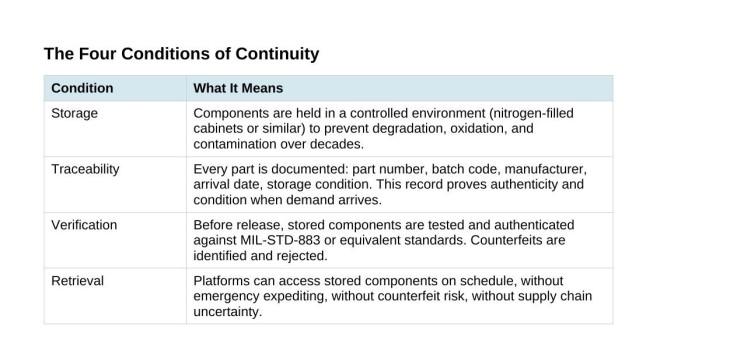
Where Long-Term Storage Fits in Your Lifecycle Plan
Long-term storage is not a separate service. It is a critical capability that sits alongside your broader obsolescence management strategy. Here is how:
Early planning identifies at-risk components. During platform design and procurement, your team identifies parts likely to reach end of life before the platform retires.
Procure buffer inventory. Before the component becomes unavailable, buy additional stock. This is not indefinite typically 20 to 25 year supply for critical parts, based on failure and replacement rates.
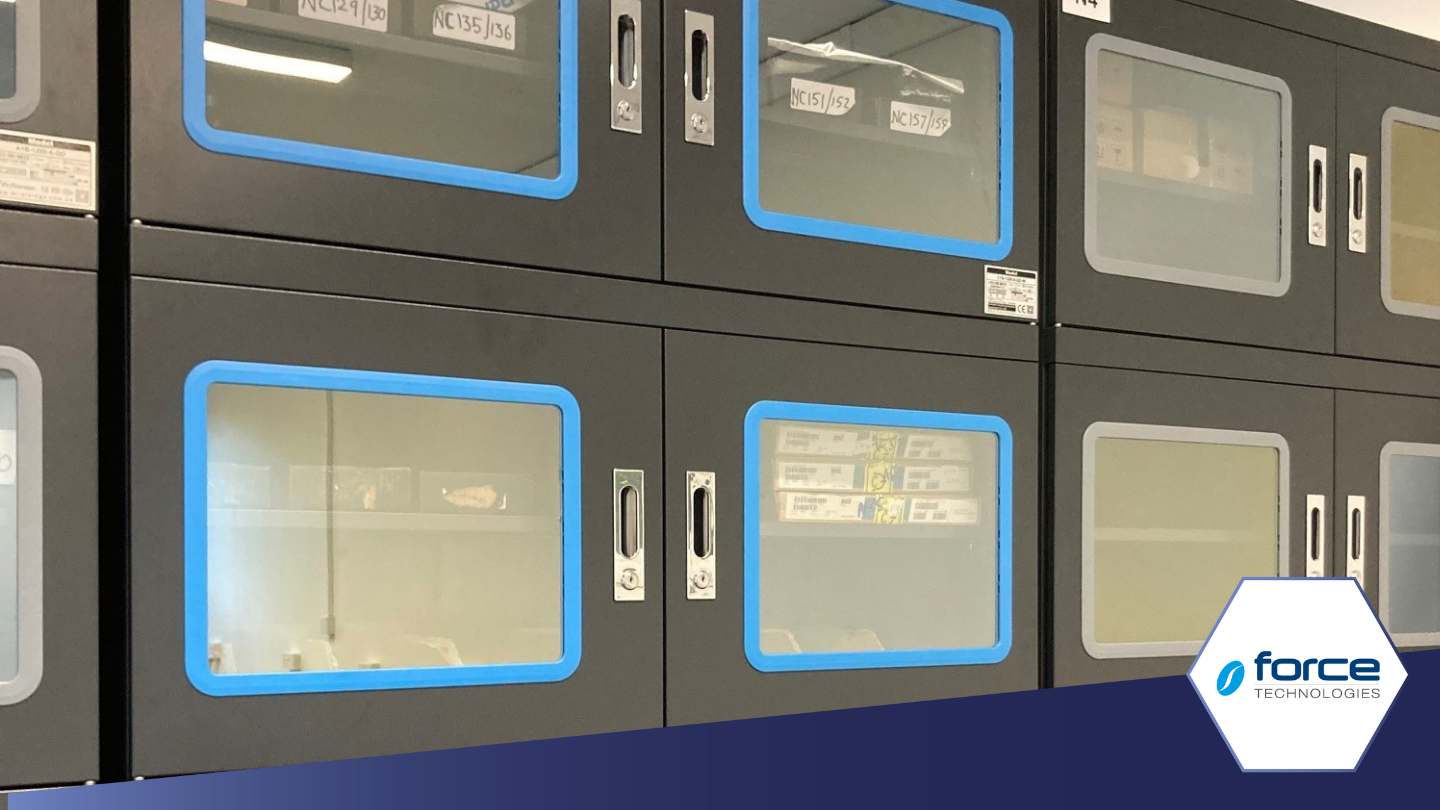
Move to secure storage. The Titan Long Term Storage facility at Force Technologies holds your inventory in controlled nitrogen-filled cabinets, preventing degradation and contamination. Temperature and humidity remain stable for decades.
Maintain traceability and compliance. Stored components are registered, documented, and regularly verified against MIL-STD-883 standards and AS6081 counterfeiting protocols. Your records are audit-ready.
Release components on demand. When a platform needs a spare part, components are retrieved, tested, authenticated, and released to your supply chain with full documentation.
Plan obsolescence replacement. As your platform ages, storage allows you to manage the transition from original parts to approved alternatives, ensuring seamless handoff without operational disruption.
The Risk of Not Having Long-Term Storage
When a defence platform operates without documented, secure long-term storage, the risks accumulate:
Uncontrolled components degrade. Parts sitting in standard warehouses are exposed to temperature swings, humidity, dust, and oxidation. By the time you need them, they may be unusable.
Counterfeit infiltration becomes likely. Without secure storage and authentication protocols, counterfeit parts can enter your supply chain undetected, creating safety and reliability failures.
Traceability is lost. Parts cannot be linked to batch codes, manufacturing dates, or compliance certifications. Your audit trail disappears.
Platform readiness is compromised. When a critical part fails, you cannot rely on your inventory to fix it quickly. Emergency sourcing becomes expensive and time-consuming.
Compliance and certification fail. Without documented storage conditions and verified authenticity, your platform cannot pass regulatory or security audits.
How Force Technologies Enables Continuity
Force Technologies addresses every dimension of long-term storage, allowing your lifecycle strategy to succeed.
The Titan Long-Term Storage Facility
The Titan facility provides nitrogen-filled storage cabinets that maintain a stable, inert atmosphere. Components are protected from oxidation, corrosion, and contamination for decades. Temperature and humidity are monitored continuously, with full audit trails. This is not improvised it is built to aerospace and defence standards.
Counterfeiting Protection
Before components enter storage and before they are released, Force Technologies authenticates them to AS6081 and AS6171 standards. Counterfeit parts are identified and rejected. Your stored inventory is verified, documented, and trustworthy.
Traceability and Compliance
Every component in storage is registered, with full documentation of manufacturer, batch code, certification, and condition. Force Technologies holds AS9100 Rev D and BS9000 certifications, ensuring that your inventory is managed to the highest standards and your audit records are always ready.
Upscreening to MIL-STD-883
Components can be upscreened to MIL-STD-883 standards before release, ensuring they meet the reliability and performance requirements of your platform. This is critical for defence and aerospace applications where failure is not an option.
Strategic Obsolescence Planning
Force Technologies helps you identify at-risk components across your platform lifecycle, recommend buffer inventory levels, and plan the transition to approved alternatives. Long-term storage is the foundation; obsolescence management is the strategy that makes it purposeful.
A Worked Example: Critical Component in Active Service
Consider a avionics component that is mission-critical on your platform. The component is manufactured by a firm that will discontinue the line in 10 years. Your platform has 20 years of operational life remaining. Without action, you have a gap.
With a continuity strategy:
You procure a buffer of components today, before the manufacturer discontinues production. Based on your failure rates and remaining platform life, you order 30 units.
You ship them to Force Technologies. The Titan facility receives them, verifies authenticity against AS6081 standards, and stores them in nitrogen-filled cabinets.
Over the next 20 years, whenever your platform needs a replacement part, you request a unit from storage. Force Technologies retrieves it, tests it to MIL-STD-883, confirms authenticity, and ships it to your supply chain.
Your platform never faces a shortage. No emergency sourcing. No counterfeit risk. No compliance uncertainty. Full continuity.
The Business Case for Long-Term Storage
Long-term storage is an investment that pays for itself multiple times over.
Plan with storage Upfront buffer procurement plus storage fees. Cost is predictable and spreads across the platform lifecycle.
Plan without storage Emergency sourcing of obsolete parts costs 2–5 times more per unit. Unplanned logistics delays operations. Counterfeit risk creates liability.
Net benefit Planned storage is substantially cheaper over the platform lifecycle, while eliminating operational risk and compliance uncertainty.
Taking the Next Step
If your platform operates across a multi-decade lifecycle, long-term storage is not optional—it is essential infrastructure. Force Technologies can help you:
Identify at-risk components in your current BOM (bill of materials).
Calculate buffer inventory requirements based on failure rates and platform life.
Authenticate and store components securely in the Titan facility. Release components on demand, with full compliance documentation and traceability.
The continuity principle ensures that your platform remains operationally ready for its entire lifecycle. Long-term storage is how you make it work.
Bring your component list and lifecycle timeline to a conversation with Force Technologies. Let’s build a storage and obsolescence strategy that keeps your platform supplied for 20+ years.