

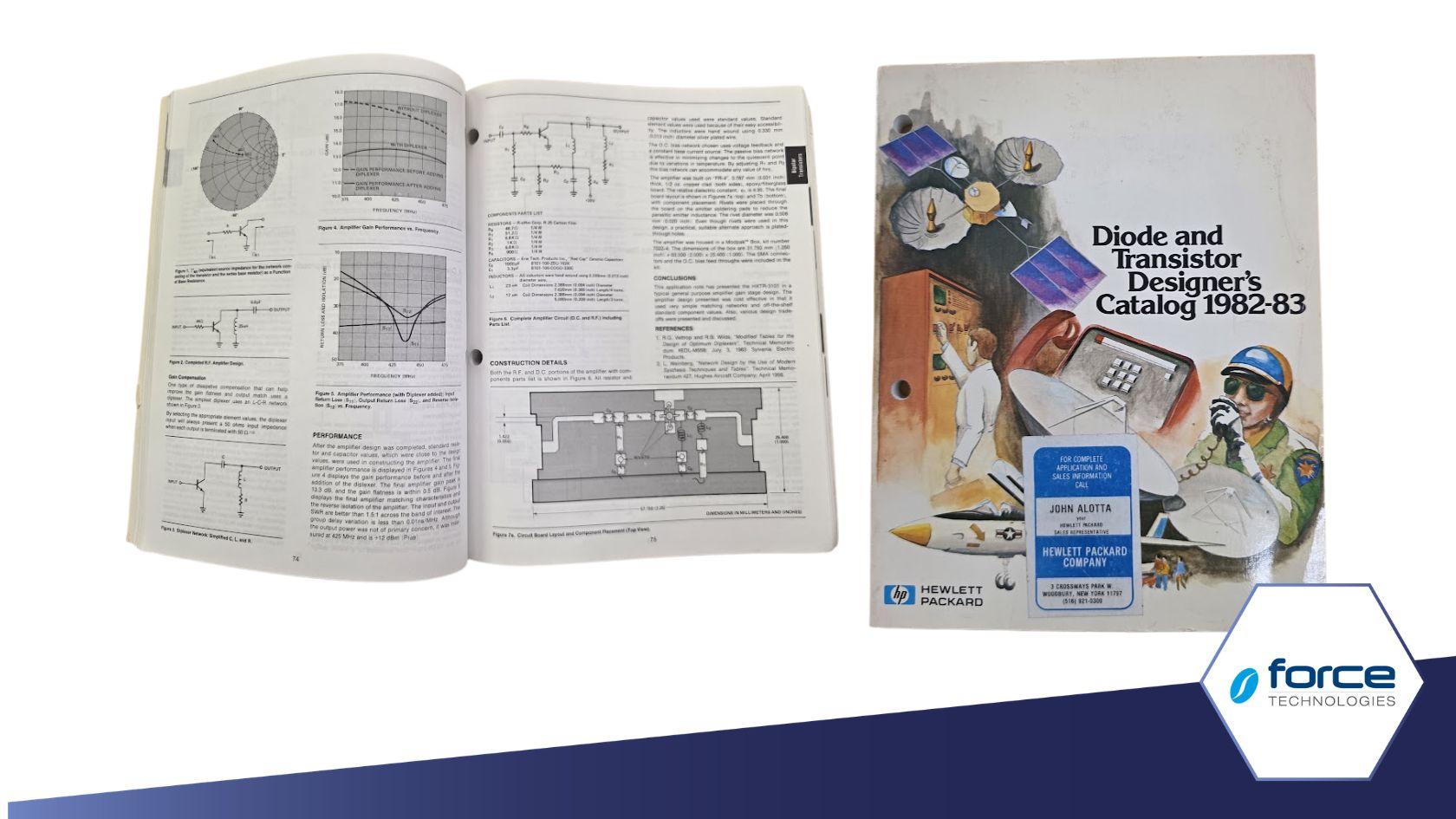
We’ve added another volume to our reference library: the Hewlett-Packard Diode and Transistor Designer’s Catalog for 1982-83. It joins the growing collection of original manufacturer databooks we keep on hand for obsolescence planning work.
Why a 40-year-old catalogue still matters
When a client is trying to keep a legacy system running, the part number on the board is only half the story. To find a modern equivalent, a suitable cross-reference, or a safe last-time-buy candidate, you need the original electrical characteristics as the manufacturer published them. That means the actual data sheet, with the actual test conditions, the actual curves, and the actual package drawings.
Modern online databases are useful, but coverage of pre-1990 semiconductors is patchy. Values get transcribed incorrectly, footnotes go missing, and whole product families simply aren’t listed. The original printed databook is still the most reliable source.
What’s inside this one
The 1982-83 HP catalogue covers the discrete diode and transistor lines Hewlett-Packard was selling to design engineers at the time. Expect Schottky diodes, PIN diodes, step recovery diodes, hot carrier diodes, and the RF and microwave transistor families that HP was known for in that era. For anyone maintaining test equipment, radar, microwave links, or instrumentation from the 1980s and early 1990s, this is exactly the sort of reference that answers questions nothing online can.
How we use it
When a client comes to us with an obsolete part, we work through a standard sequence: confirm the original specification, identify form-fit-function replacements, assess authorised stock, and where nothing suitable exists, plan a redesign or a last-time-buy. Databooks like this one sit at the first step. Without them, we’d be guessing.
Our databook collection
We hold hundreds of original manufacturer databooks going back to the 1960s, covering the major and minor semiconductor houses of the period. If you’re chasing a part we might have documentation for, get in touch and we’ll check.