

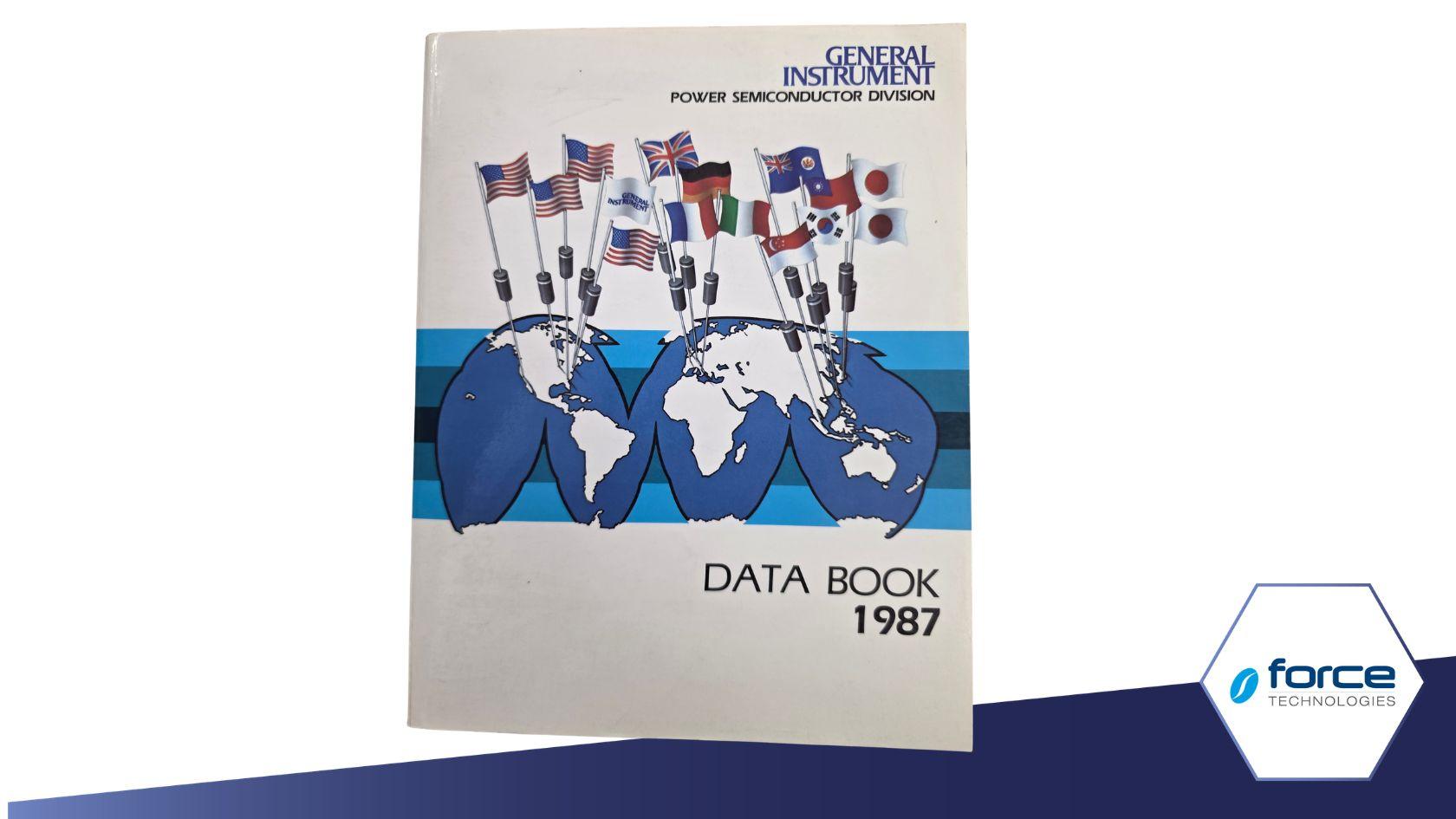
The 1987 General Instrument Power Semiconductor Division data book documents the JAN and JANTX rectifiers, Schottky diodes, fast-recovery rectifiers, bridge rectifiers and transient voltage suppressors that still sit inside legacy military, aerospace and industrial hardware in service today. General Instrument’s power semiconductor business became General Semiconductor in 1997 and was acquired by Vishay in 2001, so the original part markings on a 1987 board rarely match anything a modern distributor lists. This is exactly the paperwork that lets Force Technologies identify, cross-reference and re-source those parts.
Why we are sharing this data book
Force Technologies keeps a working engineering library of manufacturer data books stretching back to the 1970s. Very few of these documents exist online in a usable form, and where scans do exist they are often incomplete or missing the application notes. The 1987 General Instrument Power Semiconductor Division data book is one of the more useful volumes in that collection because GI’s power devices ended up in an enormous installed base of defence, aerospace, industrial control and telecoms equipment that is still in service.
What the 1987 data book actually covers
The book documents the full power discrete range General Instrument’s Hicksville, New York division was shipping in that year. Grouped into six product families:
| Family | Typical current range | Common uses in 1987 hardware |
|---|---|---|
| JAN, JANTX and JANTXV rectifiers | 0.2 to 6.0 A | Military and space power rails requiring MIL-S-19500 screening |
| Schottky rectifiers | 0.6 to 40 A | Low forward-drop rectification in switch-mode PSUs |
| Fast and ultra-fast rectifiers | 1.0 to 30 A | Freewheel diodes in inverters, motor drives, SMPS output |
| Superectifiers | 0.4 to 3.0 A | High-reliability signal and low-power rectification |
| Bridge rectifiers | 0.9 to 35 A | Mains input stages, industrial control gear |
| Transient voltage suppressors | Various | Surge and lightning protection, including automotive variants |
The book also stresses General Instrument’s process signatures of the period: metallurgically bonded junctions, glass passivation and flame-retardant encapsulation. Those construction details matter because they drive the failure modes engineers see decades later.
Why a 1987 data book still matters in 2026
General Instrument spun its power business out as General Semiconductor in 1997, and Vishay acquired General Semiconductor in 2001. That corporate journey means the GI-branded part number stamped on a 1987 board is almost never the part number a modern distributor searches. Some devices carry forward as Vishay equivalents, some were quietly discontinued, and some only exist today as new-old-stock or through authorised last-time-buy inventories. Without the original data book, matching an old GI marking to a supported modern equivalent is guesswork.
That is why obsolescence mitigation for long-life programmes depends on paper as much as silicon. According to the US Department of Defense’s SD-22 guide on diminishing manufacturing sources and material shortages, accurate original manufacturer documentation is a prerequisite for any form-fit-function or die-level re-engineering decision. The UK MoD’s own obsolescence policy takes the same line.
How Force Technologies uses books like this
Three practical uses come up almost every week:
- Identifying an unknown part on a board. A GI power rectifier marking from 1987 rarely resolves against modern databases. The original data book gives the electrical characteristics, package outline and process family, which is enough to pin down a supported equivalent or, if needed, a die-level substitute.
- Building an evidence pack for MIL-STD-883 upscreening or AS6171 counterfeit testing. Comparing new-old-stock devices to the original 1987 specification is the only way to prove parametric equivalence to a customer’s design authority.
- Supporting form-fit-function redesign. Where an original part cannot be sourced at any grade, the 1987 data sheet defines the electrical envelope the FFF replacement has to meet.
Access
The physical volume lives in the Force Technologies engineering library in the UK. If you are chasing a specific GI power semiconductor part number from a legacy defence, aerospace or industrial platform, contact the Force obsolescence team and we will look it up against the 1987 data book and cross-reference to a currently supported route.